From the Ganges to the Padma: The water dispute flows on
With the 1996 treaty expiring in December, Bangladesh needs a new agreement guaranteeing fair dry-season flows and addressing upstream withdrawals and river management round the year
 Collected · Not taken by usCollected
With the 1996 treaty expiring in December, Bangladesh needs a new agreement guaranteeing fair dry-season flows and addressing upstream withdrawals and river management round the year
Beyond the bargaining over water shares are people whose livelihoods depend on the flow. Photo: Syed Zakir Hossain "> Beyond the bargaining over water shares are people whose livelihoods depend on the flow. Photo: Syed Zakir Hossain In a popular story, Mughal emperor Akbar (1542–1605) challenges his witty courtier Birbal to count the waves of the Yamuna River as it flows past Agra, one of the capitals of the monarch. Birbal accepts the challenge, as he always does, but says he can give an accurate count only if a royal decree stipulates that no wave may merge with another and no new wave may arrive until he finishes counting. The emperor is amused by his courtier's quick wit.
Counting the Yamuna's waves may have been only Birbal's problem in the popular story, but agreeing on a new arrangement for sharing the Ganges is a challenge for Bangladesh and India. The task is not merely to divide the water that reaches Farakka, but to ensure that upstream activities do not leave Bangladesh with inadequate water.
The issue is urgent. The 30-year Ganges Water Sharing Treaty, signed on 12 December 1996, will expire in December 2026. It was the second agreement between Bangladesh and India on sharing the Ganges waters, following the 1977 treaty. Water Resources Minister Shahid Uddin Chowdhury Anee said on 8 October that Bangladesh wants a new, longer-term agreement with a guarantee clause to protect its dry-season water share. He expressed hope that an agreement could be reached before the deadline.
India's response has been guarded. On 9 October, India's foreign ministry spokesperson Randhir Jaiswal reiterated that river-related issues between the two countries fall within the ambit of the Joint Rivers Commission (JRC). Earlier, he said technical-level meetings on the Ganges treaty were continuing. Bangladesh's Foreign Affairs State Minister Humayun Kobir has also stressed the need for dialogue and diplomacy, with international law taken into consideration.
The immediate priority is to avoid uncertainty after 12 December. The two countries could agree to extend the existing treaty as an interim measure while negotiating a new long-term agreement. After the 1977 treaty expired, the two countries signed several memorandums of understanding (MoUs) to bridge the gaps before reaching a new long-term agreement.
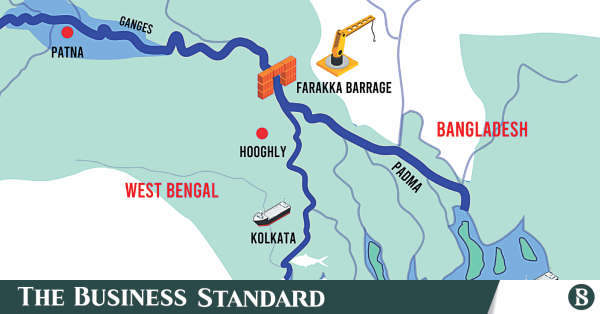
The apple of discord is the Farakka Barrage, a 2,240-metre-long structure in the Indian province of West Bengal, about 18 kilometres upstream of the Bangladesh border. Commissioned in 1975, the Farakka Barrage was designed to divert up to 40,000 cusecs or, cubic feet per second, of water through a feeder canal into the Bhagirathi-Hooghly river system to improve navigability and maintain Kolkata port.
One cusec is equivalent to about 28.32 litres of water flowing past a given place every second. The Kolkata port lies 232 kilometres upstream from the mouth of the Hooghly River, where it empties into the Bay of Bengal, and is accessible to ships through the river.
Visual: TBS "> Visual: TBS The barrage has been a bane for Bangladesh . Since the Farakka Barrage began operating, dry-season flows of the Ganges in Bangladesh have declined significantly, while monsoon flows have increased. These changes have disrupted the country's social and ecological systems, affecting fisheries, forestry, agriculture and navigation, while worsening coastal salinity intrusion. Salient features of the two treaties
Both the 1977 agreement and the 1996 treaty made arrangements for sharing Ganges water at Farakka point from 1 January to 31 May, dividing the period into successive 10-day intervals. But neither established a fixed allocation formula for the remaining seven months of the year.
The 1977 agreement's schedule under Article II (i) shows that Bangladesh was allocated more Ganges water than India was scheduled to withdraw at Farakka in every 10-day period from 1 January to 31 May. For example, during 1–10 January, India was to withdraw 40,000 cusecs, while Bangladesh was to receive 58,500 cusecs.
Even towards the end of the dry season, Bangladesh's scheduled share remained higher. During 21–30 April, it was allocated 34,500 cusecs, compared with India's withdrawal of 20,500 cusecs. The schedule was based on 75% availability calculated from recorded Ganges flows at Farakka between 1948 and 1973.
The 1977 agreement included an 80% guarantee for Bangladesh under Article II(ii). Its second proviso stated that, even if the Ganges flow fell so low that Bangladesh's share dropped below 80% of its scheduled allocation, India must release at least 80% of the amount allocated to Bangladesh in the schedule during the relevant 10-day period.
Under the 1996 treaty, Article II(i) introduced a different formula for sharing Ganges water at Farakka. The formula, set out in Annexure I, provides for an equal split when the available flow is 70,000 cusecs or less. When the flow is between 70,000 and 75,000 cusecs, Bangladesh receives 35,000 cusecs and India gets the remainder.
When the flow is 75,000 cusecs or more, India receives 40,000 cusecs and Bangladesh gets the remainder. The indicative schedule in Annexure II is based on average flows recorded over 40 years, from 1949 to 1988.
The 1996 treaty also included a special arrangement under Annexure I, requiring each country to receive 35,000 cusecs of water in alternate three 10-day periods between 11 March and 10 May. According to the schedule in Annexure II, Bangladesh was to receive this guaranteed amount during 11–20 March, 1–10 April and 21–30 April, while India was to receive 35,000 cusecs during the other three periods. These periods are marked with asterisks in the schedule.
Under Article XI, if a disagreement arises over adjustments following a periodic review under Article X, India must release at least 90% of Bangladesh's share, as calculated under Article II, until the two countries agree on revised water flows.
সংবাদ সূত্র
এই বিভাগের আরও খবর
 Collected · Not taken by usCollected
শাক্যমুনি বৌদ্ধ বিহার নির্মাণসহ পাঁচ দাবিতে মানববন্ধন
২৭ নভে, ১১:১৯ PM Collected · Not taken by usCollected
গোপালগঞ্জের লোকজন দিয়ে সন্ত্রাস করিয়ে লাভ হবে না: আইনমন্ত্রী
২৭ নভে, ০৭:৪৯ PM Collected · Not taken by usCollected