Energy crisis is now an investment crisis
In July 2026, UN Conference on Trade and Development (UNCTAD) released its World Investment Report 2026. The report bought some good news on foreign direct investment. FDI inflows increased by 45 per cent to $1.78 billion in 2025. The last two years of decline came to an end and Bangladesh is now a
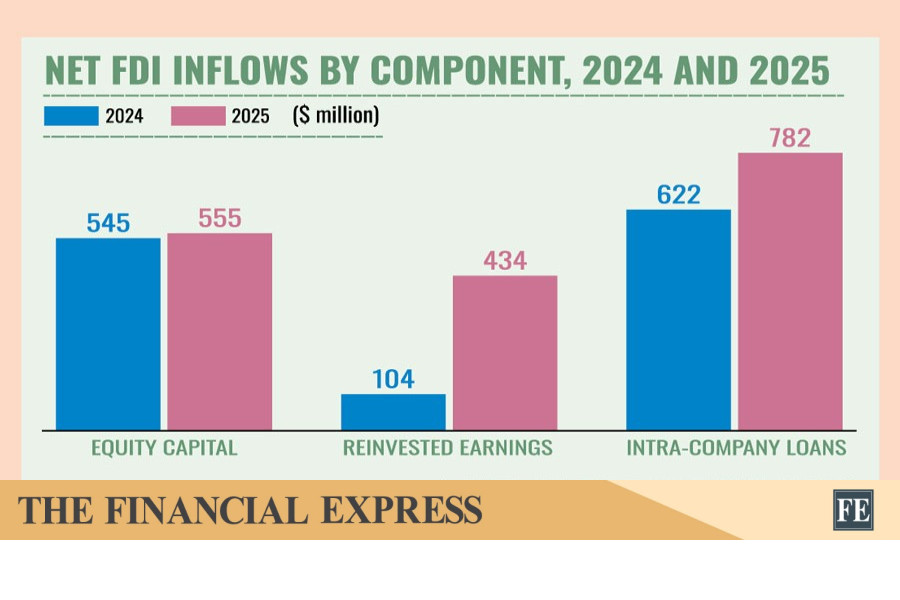
In July 2026, UN Conference on Trade and Development (UNCTAD) released its World Investment Report 2026. The report bought some good news on foreign direct investment. FDI inflows increased by 45 per cent to $1.78 billion in 2025. The last two years of decline came to an end and Bangladesh is now at third place in terms FDI in South Asia after India and Pakistan. The current government took office in February this year with an agenda of high investment, so this is a genuine win.
A deeper analysis shows that the recovery is fragile. Its biggest threat comes not from politics or global markets but from the country's own energy instability. Energy insecurity can no longer be treated merely as an infrastructure problem. It has become an investment risk that raises both the cost and the uncertainty of doing business. Mobile and export-oriented capital has plenty of alternatives. The same UNCTAD report shows that South-East Asia overtook East Asia in 2025 as the largest FDI recipient in developing Asia.
Eight months into the new government's tenure, the economic picture remains mixed. The Bangladesh Bureau of Statistics (BBS) estimated in June that the economy had crossed the half-trillion-dollar mark for the first time in FY26. Its quarterly accounts released in October put FY26 growth at a modest 3.68 per cent. Industry is precisely where the energy crisis bites hardest. It contracted by 0.28 per cent in the January-March quarter.
In early September, Petrobangla was meeting gas demand of around 4,000 million cubic feet per day (MMCFD) with only about 2,331 mmcfd. Load-shedding reached 3,341 megawatts (MW) on one night after peak electricity demand had crossed 18,000 MW at times in August. The Bangladesh Garment Manufacturers and Exporters Association (BGMEA) estimated that production in the sector had been disrupted by 30 to 35 per cent. The Bangladesh Knitwear Manufacturers and Exporters Association (BKMEA) put the disruption among knitwear makers at 40 to 50 per cent.
None of this is entirely new. The World Bank's Enterprise Survey of 2022 found that Bangladeshi firms experienced an average of 26.2 electrical outages in a typical month against a South Asian average of 21.4. Electricity was also the obstacle firms cited most often, named by 21 per cent of them. The costs are measurable. A widely cited study of Indian manufacturing by Hunt Allcott and his co-authors found that electricity shortages cut the average plant's revenues and producer surplus by five to ten per cent. Plants lacking their own generators were hit hardest. For Bangladesh's many small and mid-sized suppliers that cannot easily afford captive power, that is an uncomfortable lesson.
To understand why this matters for investment, one must recognise that much FDI involves relatively irreversible commitments of capital. A dyeing plant or a spinning mill cannot simply be relocated when conditions deteriorate. Investors therefore price in risk before committing rather than after. Economist Ben Bernanke showed in 1983 that irreversibility gives firms a reason to postpone investment while uncertainty is unresolved. Avinash Dixit and Robert Pindyck later formalised the point in their theory of investment under uncertainty. When an investment is irreversible, uncertainty increases the value of waiting.
In short, investors rarely say no. They say "not yet". Energy insecurity works through the same channel as exchange-rate volatility or an unpredictable tax regime. The difference is that it is generated at home rather than imposed from abroad. A firm unable to predict its gas pressure next quarter cannot reliably price its export contracts. Nor can it price its diesel backup costs or its exposure to buyer penalties.